I’m always looking to expand my library with worthwhile resources. One key for me is that I can reference the material more than once. I have experience running the Gun Option Run game for the last 10 years. I have seen it evolve a lot over this period of time. Zone Read, Veer Option, Midline Option, and now Dash Option. My favorite is the Veer Option, well actually it is Midline but it always seems to get my QB beat up too much…
My first exposure to the Gun Offense taught me that the tailback’s alignment in the Gun Offense started at even depth with the Quarterback.
Next. the tailback moved back so to provide a better mesh.
The problem is that it is a presnap key for the Defense. If the defender
is aligned away from the RB, they would key the RB running ZONE. If the
defender is aligned TO the RB, they would key the QB running ZONE READ
or SPEED OPTION. So put the RB behind the QB and NO PRESNAP KEY!
I had thought of
this idea about six years and then discovered it was Nevada’s base offense.
I referred to it as Power I Gun (PIG for short). Here are some old school clips from that “Era” (Coaching sophomore football…Forgive
me for the crude film job).
I decided to buy the eBook version and am
glad I did! I am able to read it on my Laptop and my iPhone (The iPad mini is a
near future purchase). For the teams I have coached, the Pistol formation has
provided us with a more downhill path for our tailback. When we are in a one
back set, it doesn’t give a presnap key to the Defense.
Coach Vint’s book is well laid out and easy to read.
The book contains sections on:
MIDLINE CONCEPTS
MIDLINE COMPLEMENTS
VEER CONCEPTS
LOAD and LEAD OPTIONS
ZONE READ GAME
TRAP READ CONCEPTS\
COUNTER READ CONCEPTS\
SHOVEL OPTION CONCEPTS
FRONTSIDE READ CONCEPTS
At first glance I thought I found a grammatical error,
complement. But I learned something new from our friends at Google. Complement
I am verbiage junkie. I love to see how other teams call
their formations and plays. Coach Vint uses a number to set his Fullback. It is
easy to learn and flexible. I may look into incorporating this into our offense
next year. Plus the tags are great too! (Boss,Cobra,Cowboy, and Hoss)
Coach Vint uses a phonetic system for his motions. I have
always been torn how to name motions.
Only one name for the motion and
tag the player.
Examples: H Zip, X Zip, S Zip
Motions that are specific to
players.
Examples: GLIDE is only used by
the HB, JET is only used by the SLOT
Use a Phonetic system.
Zip = Z into formation
Fip = F into formation
Yip = Y into the formation
Tip = T into formation
This is still been a challenge for me. Could the players confuse ZIP,FIP,YIP and TIP?
Coach Vint answered
"Never had an issue with it. We rarely have two guys go in motion, and they did a good job of remembering what the ips,aps, and ops meant."
He continued
"I built the system to be simple. The goal was for our athletes to be able to play fast. Our verbage was simple and allowed them to play fast without thinking."
I would have like to see Coach Vint go into more detail
about QB and RB steps for the base plays. However, I did understand all the plays and know that when you are in the gun, you can over-coach the footwork. For a more detailed look, check out an old article.
We are a big two back team, the problem was the backfield
set would give a presnap key. So we decided to try putting both back behind the
QB. I only have one clip…hopefully I will get myself into gear and breakdown
our whole season.
Here are my some of my favorites from the book, for the rest... you gotta buy the book!
I would highly recommend buying this book. Coach Vint did an
excellent job and he is very accessible…
As Alabama was scoring again...I wondered how did they get sooo wide open. As a Notre Dame fan, it was
difficult for me to watch the first time, but for the sake of learning (and
writing a long overdue blog article) I RE recorded the game. I hate to admit, but I deleted the game as soon as the 4th
quarter was finished... Not to confuse this with when the game was over, which
could have been end of the FIRST quarter!
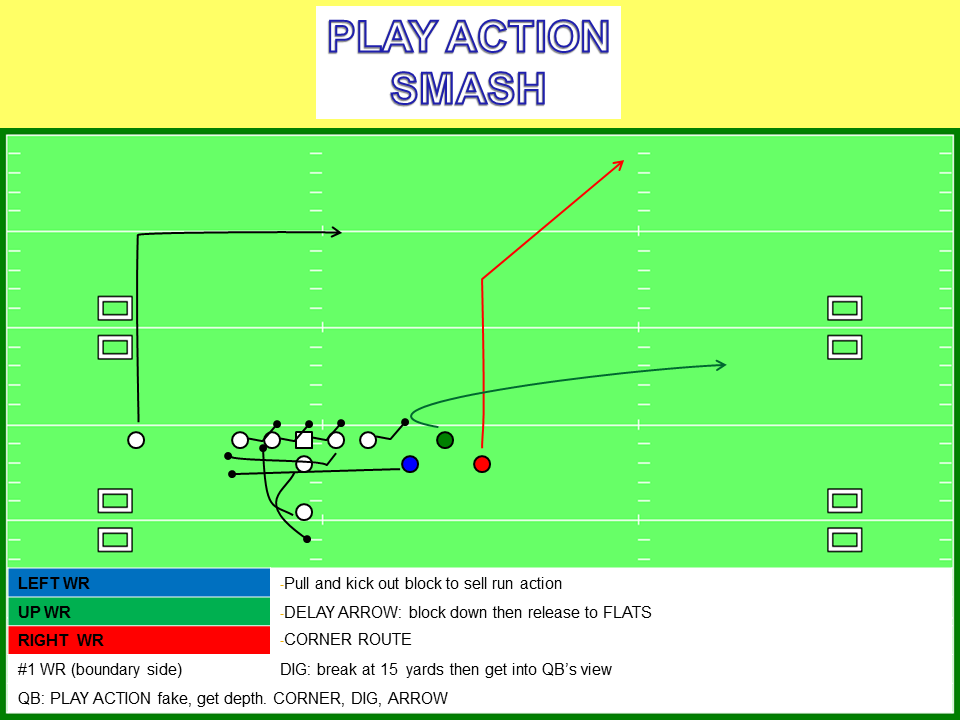
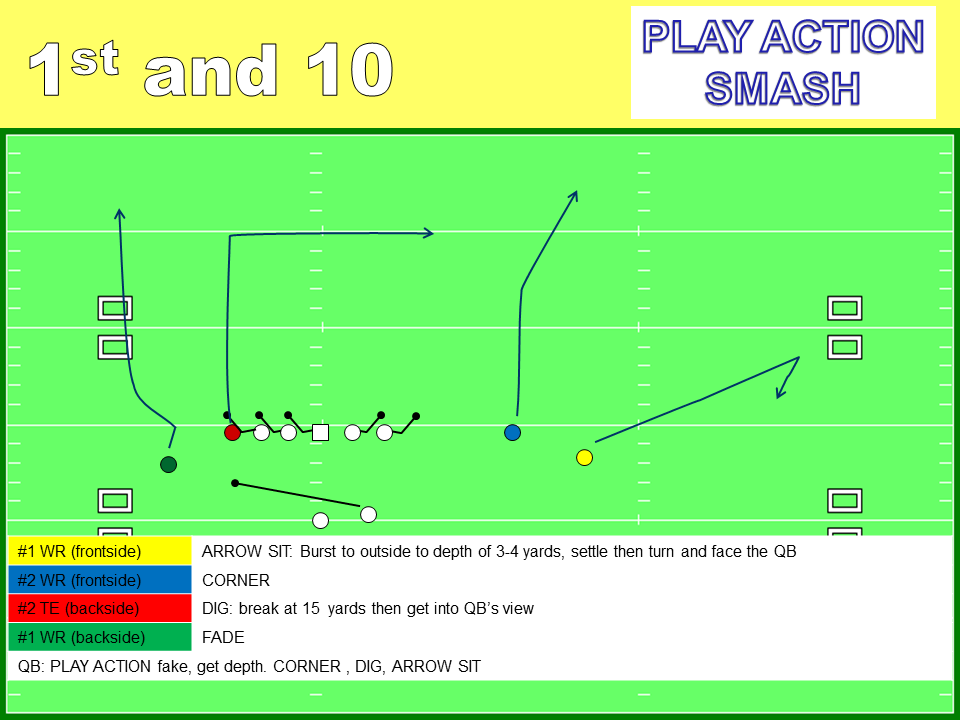
Most of the deep routes were a pretty
typical CORNER route, but could it be the traditional SMASH CONCEPT that beats
Cover Two?
SIDE NOTE: I have always loved the SMASH
CONCEPT and it had been a staple part of our offense. The problem we had was
the Cornerback's drop. Some of the cornerbacks we faced were able to squat on the
HITCH then rally to the CORNER or cloud the read of the QB just enough to
frustrate us… Luckily we discover the SNAG or SCAT CONCEPT.
Okay, back to the game, or beat down… Alabama was creative in how they kept the
coverage of the corner back low. Not a traditional HITCH route which is
normally paired with the CORNER. They
used a delay arrow (or flats) route and a pivot route.
The Tide also used three other components
PLAY ACTION: It seemed like almost every
pass was PLAY ACTION. It helps to have an impressive run game. But they also utilized
it on FIRST DOWN!
COMPRESSED FORMATIONS: Basic tight BUNCH
set or 2x2 formation.
MOTION: They would motion from Bunch or
TE Trips to a 2x2 formation.
So with pencil and paper ready, I was able to review the pass plays. Then I took some extra time to put them all in a short PowerPoint. Some of the plays I was able to get the down and distance. I had planned to get some screen shots ala SMART FOOTBALL, but I am still a rookie when it comes to that technological savvy.
One of the final pass plays wasn't the SMASH concept, but it looked like the backside WR ran a " Y CROSS "type route.
I just finished Coach Kelley's DVD from American Football Monthly and here are some notes I took while watching the DVD.
By not punting you are increasing your opportunity for a first down.
The amount of yardage you need on each play changes when you adopt this philosophy
3.3 yards for 3 downs
2.5 yards for 4 downs
Punting-Teams spend an inordinate amount of time not turning the ball over. Then why would you just give the other team the ball.
How you acquire the ball changes your percentage of scoring.
Via Kick off on own 20/30 yard line teams score about 17% of time
Via fumble/interception teams score 34% of time from same spot on field
If you have ball on your own five and choose to punt.
The average net punt is 32 yards
Therefore, you are still giving your opponent a 77% chance of scoring
If you go for it turn the ball over on downs you are giving the opponent a 92% chance of scoring
His contention is that a decrease of 15% is not worth punting the ball
Additionally, they have found out that when they go for it on 4th down and convert their team scores on 76% of the drives.
Not making first downs is an offensive failure
Benefits
Play calling changes-You can run the ball on 3rd and 8 to put the offense in a favorable 4th down position.
Defense has to change the way they call the game
More practice time for other things
Offense is on field longer therefore fatiguing the defense
DaCoachMo and I have started a new forum devoted simply to spread football topics, ideas, and concepts. This board is designed by coaches for coaches who want to specifically speak about the technical aspects of the spread offense. Joining the forum is free and all are welcome to discuss their favorite components of the offense.