Not since the incredible "Mind Blower" by Coach Keith Grabowski, have I been this impressed by anything out in the cyberspace.
I was able "enroll" in this Teachable course. And I was blown away at the sheer amount of content. Over HOURS and HOURS of videos!
Ten Chapters of information include
Welcome
RPO Overview
The Keys To Learning Any RPO
The Run
The Pass
The Option
Why Do RPOs Fail?
How to Protect RPOs?
Bonus Material
Next Steps
Here is a small preview of the course...
This course is not just for a coach, but a fan or player. Coach O'Sullivan details each part of the RPO. What pass options he likes best. Here is one example.
Coach O'Sullivan use the Power Playbook from Just Plays Sports Solutions.
This short article cannot do justice to Coach's course. You just need to "enroll" in it.
You can follow him on Twitter... in two places!
Oh, and he has a YouTube channel that is excellent.
In addition to the RPO course, Coach O'Sullivan has two other Teachable courses. So much content, how can anyone sleep?
And here is a freebie from Coach!
Coach O'Sullivan loves to talk ball... He has been on Coach McKie's channel several times.
Okay so it may be pricey.... whatever...
It is a high end product. No echo or no lighting issues. Annotations are spot on thanks to a Wacom tablet and Epic Pen tool (Soooo cool, I bought both!). BUT, Coach O'Sullivan is always running specials for his courses, be on the lookout. But really the price of the course may be equal to what you could have spent on hotel rooms, beverages, and food this past year. The difference... This expands your mind not your waistline. And never goes away.
Note: Be aware this course is long! It takes time to digest! I did watch sections several times.
RPO stands for Run Pass Option, but in Coach O'Sullivan's course it should stand for REALLY, PRETTY, OUTSTANDING.
Make sure you have signed up for our mailing list below.
•The average HS team has 15 3rd down plays a game and 33% of those in
the Red Zone.
•Have a plan from 5-20 and for inside the
5.
•OK, to have a special package for inside
the 5!
•We carry 6-8 special Red Zone plays for
5-20, we practice 3-4 a week starting in the pre-season and pick the best 3 to
take into the game weekly, if we use 1 in a game we rotate in another one
What additional plays did we find that worked?
1. We developed a inside the 5 package based on the Single-Wing but we also used this all over the field.
2. If you have been reading this blog, you know that I am a heavy snag team we found variations.
We added a variation to our 2 man snag play Thanks to Brennan Marion..
We tagged our snag play with slot fade a lot more this year and it work wonders
Please make sure you check out the clips below, thought process and links!
************************BELOW IS THE ORIGINAL ARTICLE************************
Scoring in the Red Zone is essential to all offenses. Teams that are in the Spread can have problems when they get inside the 20.
I divide the Red Zone into 3 Sections 20-13, 13-5, 5-0. In my experience that is when the defense makes changes, at the 13 and then again at the 5.
#1 High 20-13
Think normally, think Smash and Snag concepts in the passing game and stay normal in the run game.
Smash for us is
#1 WR has an IN
#2 WR has an IN
#3 WR has a CORNER
3 man Snag have worked great for us... pretty standard
#1 WR has the SNAG
#2 WR has the CORNER
#3 WR has the BUBBLE
We had success with 2 new variations this of Red Zone offense due to our use of an H-Back this past season!
#2 From the 13 -5
We run a lot of Inside Zone slice and Run Pass Options. We used this to our advantage, especially because for us a number of the teams we play play man coverage in the Red Zone. Here are two clips of us using a play-action shot in the Red Zone! We would motion a back into the backfield and fake Inside Zone Slice with a wheel concept.
#3 Inside the 5
Our Best Play this year inside the 5 was getting a H-back and TE in the game with the ability to run Inside Zone Slice Downhill at teams. But most teams will put 9 in the box and go press man on the outside so our QB could throw fade to either side
Have a game plan for the Red Zone in the Spread.
Don't be afraid to have a heavy package inside the 5, H-backs, double tights or Single Wing.
Need Ideas for the Red Zone? The link below is my Coach Tube Class on it. Steal these 2 plays to install for your playoff run or for next year!
Watching a Nike COY clinic video on Dana Holgerson and he said the following.
If you are fast all the time defense loves it.
If you are slow all the time defense loves it.
If you vary it, then defense not so happy......
When I was a young play caller, I had the attitude of tempo meant everything! I wanted to go fast! I wanted to run as man plays as I could, I thought it didn't really mater what I called on 1st and 2nd down, the only down where slowing it down could matter was 3rd down. As I have progressed I can tell you that is not the same philosophy I have today! Varying tempo and knowing when to use it is important as ever.
A few years ago, I heard Neal Brown at a clinic talk about his Blur package a collection of plays that he would run to use tempo anywhere on the field. Basically, the were base plays packaged and ready to go on a moments notice.
Here is a sample of the Blur package we used in the past as HC.
Blur 1
Blur 2
Blur 3
Blur 4
One thing I wanted to do was combine Tempo with the ability to run downhill. Coach Steve Addazio said it best.
So what did we evolve to you ask?
This is a question I have answered in my new CoachTube class, named Tempo Plays and One Word Calls in Your Offense.
The ability to use one word plays to control tempo. We have about 7 or 8. We call them when most convenient for us. If you have followed this blog, you know I am a huge fan of zone-stick. In this class I show how it became a one word play for us, where we would rotate the formation to best fit us weekly.
To find out more about our one word plays and how we use them to control the tempo in our power spread offense click here.
Make sure you have signed up for our mailing list below.
3 Ways Using The Tight End can improve your Passing Game & RPO Clinic Tape
******** IF You are reading this BLOG Post between 11/26/2019 and 12/4/2019, all of my coachtube classes are 65% off for Black Friday and Cyber Monday --> CLICK HERE ***********
3 Ways we have used the TE to enhance our offense are as follows.
1. Flood is a great concept, very rarely do I run Sprint Out, however this was our most effective Flood Pass, great explosive and great on third and 7+
2. Depending on how much of a weapon your TE is, Trips usually pulls the coverage towards it and that leaves a chance to run weak flood, if teams run what is known as "Steal" coverage.
Combining Smash with Drive, gives us a great weak flood concept...
3. Throwing Verticals has a lot to do with spacing, one of the best ways to formation a defense is using Empty with one or multiple tight ends. Depending on how teams rotate you can get a vertical shot called combined with seam read and shallow allowing for shallow dig as a response or a quick seam shot.
Here is film on all 3 concepts.
RPO Clinic
Here is film on Study Tape for RPO's.. I have been holding on to this one for a LONG TIME. I think you will find something useful or it will reinforce something that you do!
Make sure you have signed up for our mailing list below.
I have been reading and received a number of comments about the bash concept that is currently being employed by offenses across the football landscape. I thought I would take the time to put my thoughts about the play to paper. But before I begin on my explanation of the bash play I think it is important to speak about the zone read.
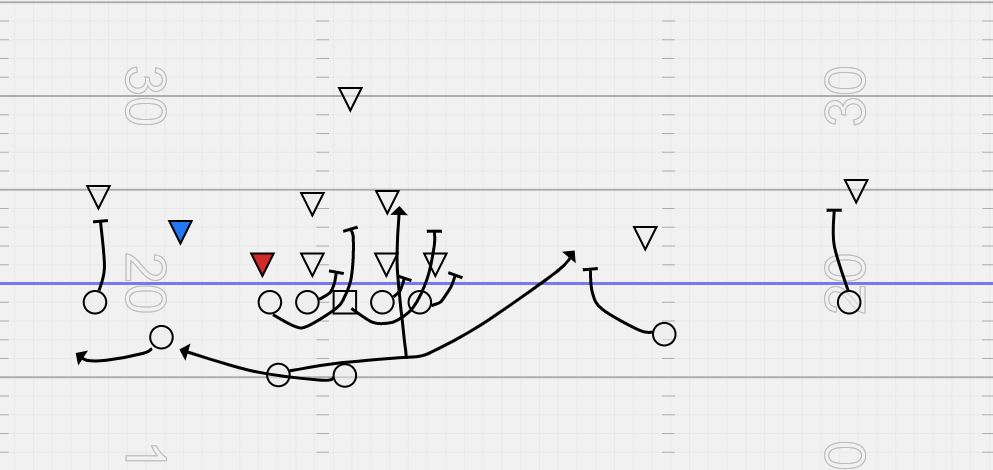
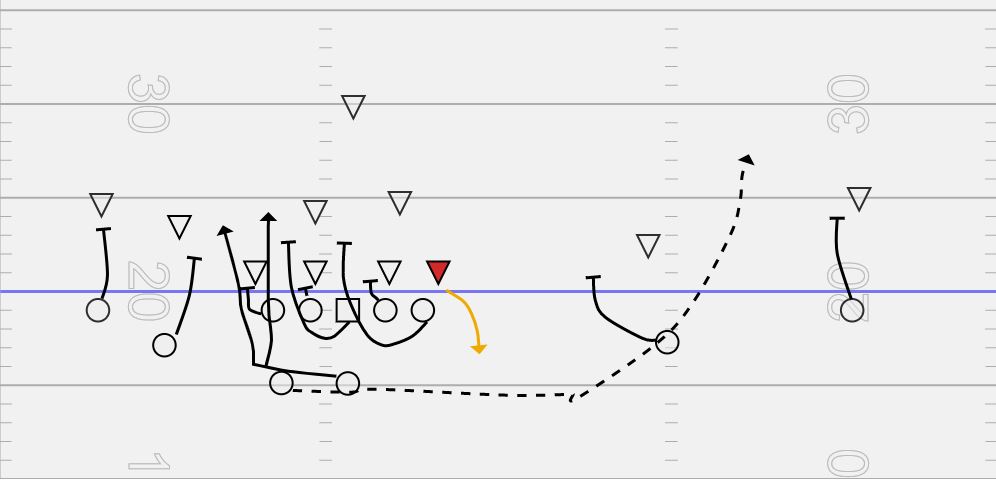
ZONE READ RIGHT
(Figure One)
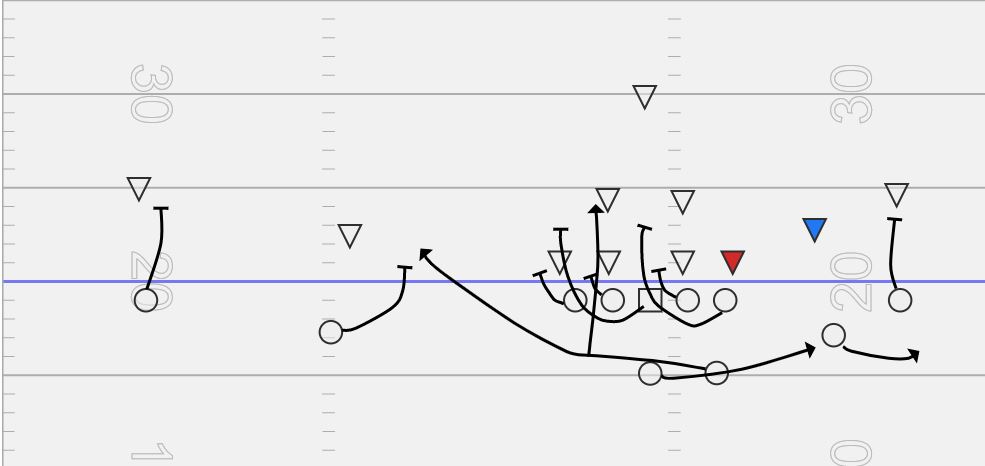
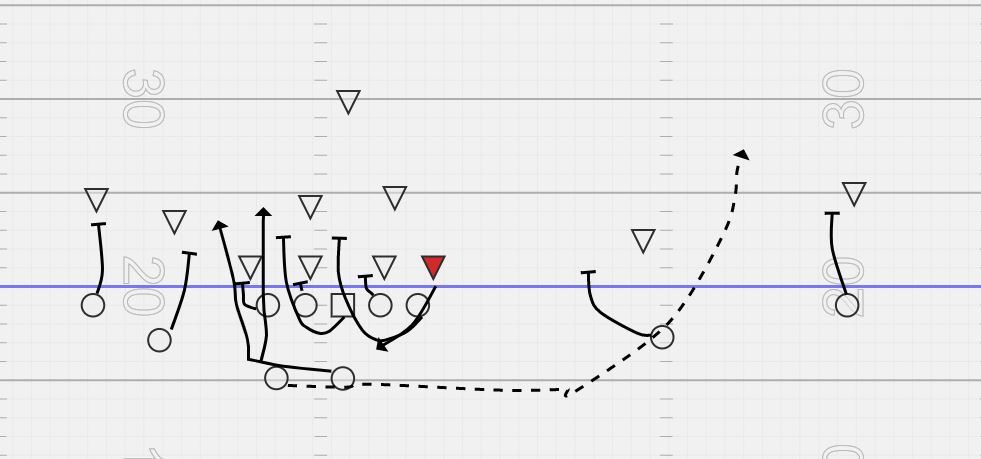
ZONE READ LEFT
(Figure Two)
In both of these examples, you can see diagrams for the outside zone play to the right (Figure One) and the outside zone play to the left (Figure Two) both of these examples call for the uncovered offensive linemen to pull into the first vertical seam they can find along the line of scrimmage (LOS). Please note the red triangle is the presnap read key for the quarterback on the outside zone play. The number two wide receiver on the backside of the run is running a bubble route. (Coaching Point-Make sure you have your backside wide receiver chop their feet in place prior to extending on the bubble)
ZONE READ QB PULL LEFT
(Figure Three)
ZONE READ QB PULL RIGHT
(Figure Four)
In both of these examples, you will see the quarterback reading the backside defender. In the two examples (Figure Three and Figure Four) the quarterback reads the backside defender. In both of these examples, the backside defender comes upfield and is on a path to disrupt the outside zone play to the running back. Upon observing the defensive end and his post-snap movement the quarterback pulls the football. Immediately after the quarterback pulls the ball he needs to get his eyes on the defender over the number two wide receiver (blue triangle). If the man over number two attacks the quarterback he throws the ball to the wide receiver who is running the backside bubble. If the man over number expands with the bubble the quarterback puts his foot in the ground and get vertical in the void that has been created by the vacating defender.
As defenses have evolved they have become pretty good at defending the aforementioned zone read play. Obviously the longer you run the zone read play the more iterations of defensive alignment and backside exchanges you will see defenses employ. The four examples above were a brief explanation of how to run the zone read play out of the 2x2 formation. Throughout the rest of this article, we will examine the bash play which is an excellent complement to the zone read play.
There are a number of reasons to run this play but one of the main reasons I employ it into my offense is it does not change the assignments for the offensive line. As you will see in all of the figures in this articles the offensive line is blocking the play the same exact way based upon our outside zone rules. Below you will see an everyday drill we use in our system to teach our offensive linemen to pull on our wide zone play.
BASH PLAY QB KEEP RIGHT
(Figure Five)
BASH PLAY QB KEEP LEFT
(Figure Six)
The primary difference on this play is the quarterback and the running back have switched roles on the outside zone play. The quarterback now will run the outside zone play exactly as the running back runs the play. The quarterback will read the blocks the same way the running back reads the blocks of the offensive linemen. The quarterback’s read key is still the defensive end (red triangle). After the ball has been snapped the quarterback will place the ball out in front of their body to mesh with the running back. It is important to note, that the quarterback’s eyes need to be on the backside defender. It is the running backs responsibility to mesh with the quarterback. In both figures five and six, the quarterback would keep the ball and run the outside zone based upon the post-snap movement of the defensive end.
BASH PLAY QB GIVE (RUNNING BACK LEFT)
(Figure Seven)
(Figure Eight)
As you can see if both figures seven and eight the defensive end (red triangle) crashes down and will disrupt the quarterback outside zone. Therefore, the quarterback will give the ball to the running back as he is crossing his face. Again, it is important to note, that the quarterback will have his eyes on the backside defender (red triangle). After the ball has been given to the running back we generally ask them to get outside the tackle box before they start to work up the field.
In the video clips you will see my team running the bash concept with both the outside zone and counter run game.
Two questions, I have been asked a lot via email or via DM's on Twitter is how do I do advance game planning in the off-season and what data do I pull from last season's film.
Two areas of data, I want you to focus on from last season.
1. Go research the amount of times on Possession & 10 that you got 4 yards and find out did you score. Possession & 10 is the first play of the drive. Data shows that in D1 Football teams that gain 4 yards or more on P&10 score 77% of the time. I did my data from last season and it was 79% of the time.
That led me to do 2 things a) start the play calls that got us 4 or more and b) emphasis the importance of P&10 to my kids on offense and defense. More important than 3rd down.
2. Go back and chart your Red Zone areas (20-15) (14-8) (8-3) (3-GL). What plays worked and didn't. You have to figure out a game plan for these areas.
Dear Spread Coaches, it is ok to practice and have a 2 TE, 3 H-back Goal Line Package!
If you fix these two areas and research and improve them from last year, I guarantee it will lead you to more points!
Now on to Game Planning in the Off-Season...
On each opponent you play each next that is the same as last season. You and every coach on your offensive staff should fill out a hindsight sheet.
What goes on this sheet?
1. What plays worked well? Both Run & Pass
2. What plays DID NOT work and Why? Both Run & Pass
3. What did they do to work us?
4. What did they do that we didn't expect?
5. What do we need to add for next year? Both Run & Pass?
Next, pick 6 formations and go through based on the look you got and write down 2 runs and 2 passes you should have or did use that would or did work. For example, if in 10 personnel trips and zone both ways, along with stick and flood worked, right it down. If you should have run power read weak instead, write it down.
You are coming up with a base package for next year AND you can find out what plays you are running that need more attention or less attention. For example if you installed 3 man snag but it doesn't show up in the game plan nor what worked well, maybe it's time to scale back. Likewise if you spent limited time on counter and it shows up a lot, maybe more time is needed on this concept.
Book Update
#4
I have an autographed copy and finally decided to read it! Man, why did I wait so long! When at BYU, Coach Mendenhall focused on the process of being different, what could they do well that fit them!
How they recruited players, special teams, what coaches were in charge of what, duty to the mission.
Two takeaways that I have started to use. #1 Player led special teams, he has a special team coordinator but he has a special team captain for each unit. That captain is responsible for grading film, conducting a meeting, helping the SPC decide who belongs on the unit. The SPC becomes the facilitator.
#2 Delegation of processes to help the team. Not only does he have an OC, DC and STC, Director of Football Operations but a Locker Room Coordinator, Field Coordinator, Recruiting Coordinator, Academic Coordinator, Strength & Conditioning Coordinator. I gave all my coaches a duty, told them my non-negotiables and let them do the rest! Delegate authority! It creates BUY-IN!
#5
Wasn't on my to do list UNTIL Coach Maddox released it. Take your game planning and understanding of pass concepts to the next level. If you are not a member of the r4footballsystems, BUT want to do more in the R4 process, this book is for you.
This book teaches you secondary progressions off of your primary ones and how to change 1 route to help turn a cover 3 beater into a cover 2 beater, etc.... #6
Life lessons are important for growth and the head. Using his boat as a metaphor Richard Bode helps you reflect and learn how to live your best life! Before you can win a state championship or score 50 points there is a process. You have to start with baby steps such as installation of plays and the teaching of concepts.
Next article will be coming shortly with spring football ending, also my next coachtube class is being designed as we speak!
As always......
I thank everyone who has purchased my Coach Tube Class, you can still get 20% off from this blog!
Make sure you have signed up for our mailing list below.
The Clinic The How to by Terrance Banks The first time I did this presentation was two years ago at the University of Virginia Coaches Clinic. If you have an questions, please email me or follow me on Twitter @tbanks1906 The coach listed at the end, no longer works on my staff, so contact me for questions!
"Don’t change the play, change the
presentation." Noel Mazzone
As all of us use the offseason to research changes and updates to our offenses, I have come to one conclusion, FIND multiple ways to run the
same play and not add several new plays. An example of this lies with "America’s
RPO"… Zone-Stick!