HEADER

Showing posts with label Spread Run Plays. Show all posts

Friday, January 4, 2019

The Bash Concept

I have been reading and received a number of comments about the bash concept that is currently being employed by offenses across the football landscape.  I thought I would take the time to put my thoughts about the play to paper. But before I begin on my explanation of the bash play I think it is important to speak about the zone read.

ZONE READ RIGHT 
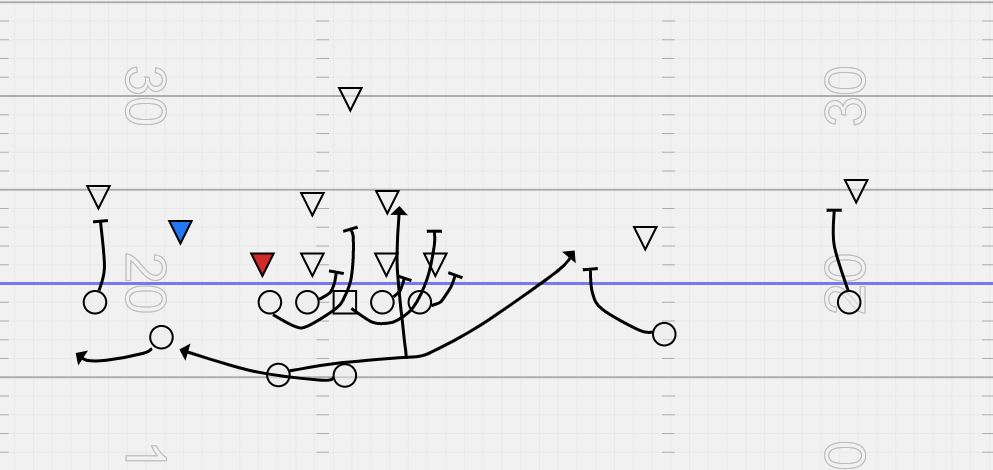
 (Figure One)


ZONE READ LEFT
(Figure Two)

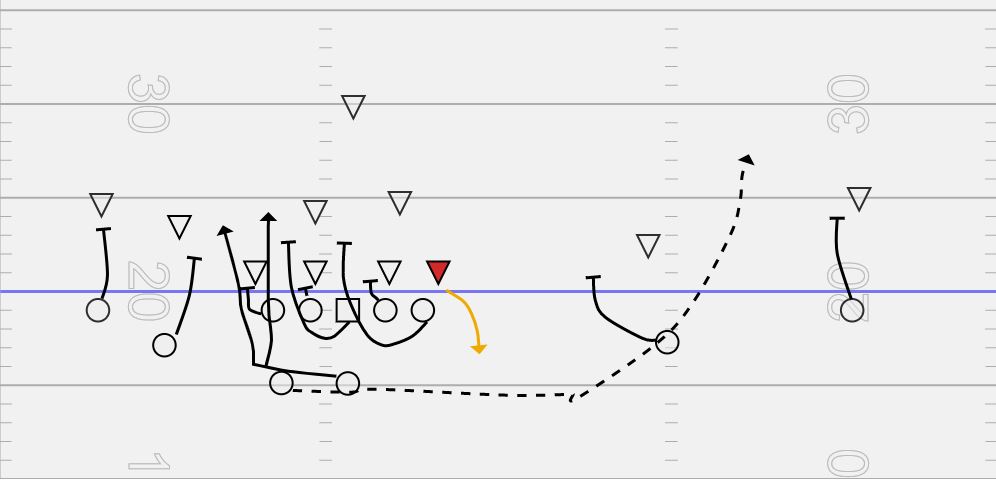
In both of these examples, you can see diagrams for the outside zone play to the right (Figure One) and the outside zone play to the left (Figure Two) both of these examples call for the uncovered offensive linemen to pull into the first vertical seam they can find along the line of scrimmage (LOS).  Please note the red triangle is the presnap read key for the quarterback on the outside zone play.  The number two wide receiver on the backside of the run is running a bubble route.  (Coaching Point-Make sure you have your backside wide receiver chop their feet in place prior to extending on the bubble)

ZONE READ QB PULL LEFT
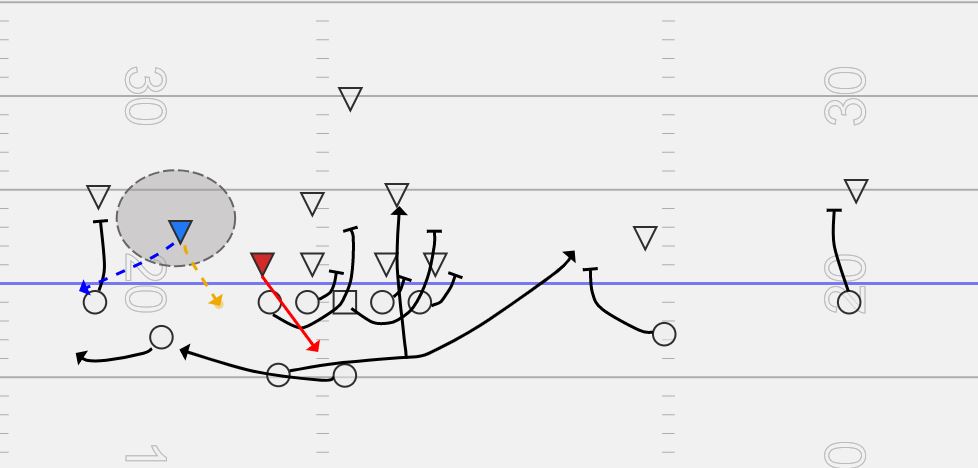
(Figure Three)


ZONE READ QB PULL RIGHT
(Figure Four)


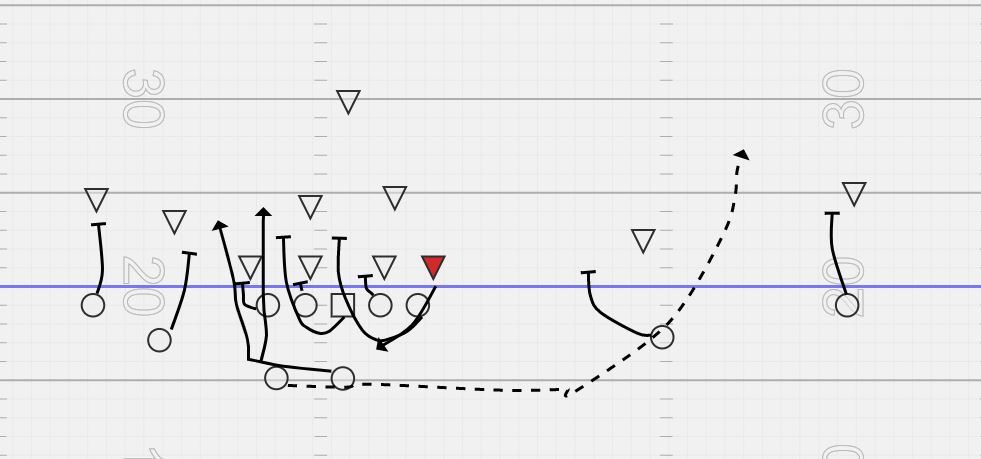
In both of these examples, you will see the quarterback reading the backside defender. In the two examples (Figure Three and Figure Four) the quarterback reads the backside defender.  In both of these examples, the backside defender comes upfield and is on a path to disrupt the outside zone play to the running back. Upon observing the defensive end and his post-snap movement the quarterback pulls the football. Immediately after the quarterback pulls the ball he needs to get his eyes on the defender over the number two wide receiver (blue triangle).  If the man over number two attacks the quarterback he throws the ball to the wide receiver who is running the backside bubble.  If the man over number expands with the bubble the quarterback puts his foot in the ground and get vertical in the void that has been created by the vacating defender.  

As defenses have evolved they have become pretty good at defending the aforementioned zone read play. Obviously the longer you run the zone read play the more iterations of defensive alignment and backside exchanges you will see defenses employ.  The four examples above were a brief explanation of how to run the zone read play out of the 2x2 formation. Throughout the rest of this article, we will examine the bash play which is an excellent complement to the zone read play. 

There are a number of reasons to run this play but one of the main reasons I employ it into my offense is it does not change the assignments for the offensive line. As you will see in all of the figures in this articles the offensive line is blocking the play the same exact way based upon our outside zone rules. Below you will see an everyday drill we use in our system to teach our offensive linemen to pull on our wide zone play.


BASH PLAY QB KEEP RIGHT
(Figure Five)


BASH PLAY QB KEEP LEFT
(Figure Six)

The primary difference on this play is the quarterback and the running back have switched roles on the outside zone play. The quarterback now will run the outside zone play exactly as the running back runs the play. The quarterback will read the blocks the same way the running back reads the blocks of the offensive linemen. The quarterback’s read key is still the defensive end (red triangle).  After the ball has been snapped the quarterback will place the ball out in front of their body to mesh with the running back. It is important to note, that the quarterback’s eyes need to be on the backside defender.  It is the running backs responsibility to mesh with the quarterback.  In both figures five and six, the quarterback would keep the ball and run the outside zone based upon the post-snap movement of the defensive end.

BASH PLAY QB GIVE (RUNNING BACK LEFT)

(Figure Seven)

(Figure Eight)

As you can see if both figures seven and eight the defensive end (red triangle) crashes down and will disrupt the quarterback outside zone. Therefore, the quarterback will give the ball to the running back as he is crossing his face.  Again, it is important to note, that the quarterback will have his eyes on the backside defender (red triangle). After the ball has been given to the running back we generally ask them to get outside the tackle box before they start to work up the field.   

In the video clips you will see my team running the bash concept with both the outside zone and counter run game. 


Bash 2x2 Outside Zone


Bash 3x1 with fly tag and counter run game


Join the conversation on Twitter follow me

@shotgunfball 

Also my blog partners

@dacoachmohuddle


@tbanks1906 


Saturday, March 24, 2018

The Bolt Offense Deaux

Back in March 2016, 2 years ago. John wrote about Coach Joe Osovet and The BOLT Offense.

Then he was still the HC of Nassau JUCO in NY, that was before he was the hottest name in college and now a member of the Tennessee Vol coaching staff.

For the past three seasons, I have been using elements of his offense and RPO's in my own offense.

That article is one of our most viewed article as coaches and UT fans alike all want to know about the Bolt Offense.

Here is a preview from the Coaches Choice videos if you wanted more information after reading our previous article. 


Attached HERE are clinic notes and diagrams on his favorite formations and a few of his RPO's and Secondary Manipulations from a online clinic he did back on twitter.

Coach Osovet does a great job with various inside zone and counter trey plays that we have come to love in the spread.

I advise you to go follow him @CoachOsovet on Twitter.

Secondly, I have been asked to share what practices from the books I have read that I am applying right now to help my team and myself as a coach.

#1 - I take 30 minutes every day, early in the morning when settled at work at my office. To clean off my desk, I do so while listening to music it helps me to focus, remove clutter and see if there was anything on my desk that needs completion that I may have missed.

#2 - My WR coach and myself have been work with WR's on getting better at blocking! We haven't focused on catching or route running... just blocking, deliberate practice trying to make or weakness our strength . Our state allows a coach to work with 4 kids at a time with a ball in the off-season. But we haven't pulled one out. We rotate working with WR's on blocking.

These two items alone, I think are helping me as a coach and my team. I am getting a lot more done and I think we will see an improvement in blocking come this Spring!

I think everyone who has purchased my Coach Tube Class, you can still get 20% off from this blog!

https://coachtube.com/course/football/using-the-stick-route-in-the-rpo-game/1758876?cpnCode=highspeedspread&track=5dfae15c07a83de1dff03a9cfaef2654


Make sure you have signed up for our mailing list below. I will have another newsletter come out before I go on Spring Break Vacation 1st week of April.


Connect on Facebook

No Huddle Tempo Practice

Our Facebook Page

Connect on Twitter

@tbanks1906
@dacoachmohuddle
@shotgunfball

Monday, November 27, 2017

POWER READ DEVELOPMENT

This off-season this was one of the plays that was sweeping the nation. The Power Read Toss. Of course, you know how this works, though "only" a local high school in Georgia, we have been running it for a while...
When Clemson started running it, the Power Read became in style.


I got a few questions, after my Power Read Video, asking do we run the toss? We have a few times, but not something that has been a major part of our game plan. I am linking two articles on The Coach B Duds's site, where you can read about his findings.
I added a few clips of us from the preseason. 


Power Read Toss from Terrance Banks on Vimeo.


Follow me on Twitter @tbanks1906

Sunday, August 6, 2017

Power Read and RPO from Coach Banks!

The Clinic

The How to 

by Terrance Banks

The first time I did this presentation was two years ago at the University of Virginia Coaches Clinic. If you have an questions, please email me or follow me on Twitter 

@tbanks1906

The coach listed at the end, no longer works on my staff, so contact me for questions!


Power Read and RPO Compliment (1818620) from Terrance Banks on Vimeo.

Wednesday, March 11, 2015

Clinic notes finally

Okay, so this how behind I am...Here are some notes from LAST YEAR!

CLINIC NUGGETS

Chuck Martin Head Coach at Miami (OH)

-Best Goal is "Be a Great Teammate"

Mick McCall Northwestern OC and QB coach

-"QBs must be able to "toe the line" of Arrogance and Confidence"

Jim Bridge Purdue OLine coach

-"Pass Protection is a PHYSICAL act"

John Shoop Purdue OC and QB coach

-"MORALE is the most important thing and the most underrated."

Casey Gillin University of Indianapolis OC

-"Be perfect! Strive for 100% completions."

Matt Theobold Franklin College (IN) OC

-"Stay with what got us down there!" (in the Red Zone)

Purdue and State notes


Thursday, March 21, 2013

2013 INDY CLINIC notes

Sorry for the long delay...I was waiting for some coaches to respond,but nothing!

INDY CLINIC 2013

I have been busy!!

  • FIRST CLINIC talk. recorded it and editing it.
  • Also been reading  Dan Gonzalez's book. The chapter on backside tags is worth the price ALONE!!
  • REVAMPING QUICK GAME
  • Helping a buddy install the offense
  • Trying to write the blog article on FORMATIONS, MOTIONS and SHIFTS.


Sunday, March 3, 2013

ONE WEEK until SPREAD FOOTBALL clinic

WHEN: March 10. (SUNDAY)
TIME: 9am-12 (REMEMBER DAYLIGHT SAVINGS TIME)
Crete Monee High School IL
20.00 per coach
SPOTS ARE LIMITED!
Email me for details
dacoachmo@homail.com
DM for details
https://twitter.com/dacoachmohuddle


We will film it AND might try to LIVE STREAM IT!!

SUNDAY MORNING slot fit our (family) Schedules the best!


Monday, July 16, 2012

My favorite run play-Counter

Since I started watching football in the mid 80s I became enamored with the counter series that was made famous by "the Hogs" in Washington.  I fell in love with with it because it was a violent play, it was simple in its execution, and it always seems to go for positive yardage.

When I started coaching high school football Da Coach Mo showed me how to run it out of the spread sets and the rest as they say is history.  It is no secret that all the teams I have coached or am currently coaching run this play and do so with a fair amount of success.

I thought I would place a couple of diagrams for you, the reader to view at your leisure when you are determining if you would like to add this play to your offensive arsenal.

 Here is an example of how we would run the counter series against the 30 stack defense.
The center and the RG would double the zero tech to the backside stack backer
The RT would down block to the Mike LBER
The LG would kick out DE
The LT wraps up to the the stack lber over the RT

Obviously this all changes if they opposing team is slanting and or blitzing gaps.
The coaching point on the counter series is everyone has a gap on the frontside and the guard kicks out the first defender off the backside of the tackle

The RB takes a jab step and crosses QBs face running inside the kick out of the guard
The qb holds ball out for the RB and carries out the fake on the backside of the play
The backside slot runs a bubble to influence the defender over them.
 The rules on the counter against a 4-1 box
In this scenario the LT and LG combo to the Mike backer
The center blocks back on the nearest adjacent defender
The RG Kicks Out and the RT wraps up to the olber
The action in the backfield is the same as the above example
Remember the front side of the play is gap responsibility and the RB needs to follow the path of the wrapping offensive tackle.
The rules for running the counter are the same as the 4-1 box except the wrapping tackle wraps up to the frontside backer.

Important coaching point on the counter series
The frontside has a gap not a man
If someone is in your gap you have to take them on the frontside
The guard is always kicking out the first person that shows outside of the playside tackle

In order to run this play successfully, you will have to spend a fair amount of time on working on combo blocks and then working to the 2nd level defender.  If you take the time to teach it and work it on a regular and consistent basis you will see the positive effects I have throughout the years.

If you would like to how we run throughout the seasons please click this link to watch my team run it.

Chicago Force Replay

If you would like to see how to implement it into your no huddle check out my manual on Amazon.com. 


Friday, June 29, 2012

Next Article

First week in July is moratorium time for football in Indiana...So I will have some time for an article or two...

The question is what to write about???

Saturday, April 14, 2012

Notre Dame Clinic nuggets

When punishing a player...
"Take away what the player loves the most...PLAYING TIME"
Brian Kelly HC

"Drills need to look like a game or they are just warmups"
Bob Diaco DC

"Use a more balanced stance and base for lateral routes to help eliminate false steps"
Scott Booker TE Coach

"You make them (OL) right, pick up theirs" in reference to RB pass protection
Tony Alford RB/Inside WR Coach

"Little Things are big in the grand scheme"
Mike Denbrock Outside WR Coach

"Only use Walk Through or Full Speed...1/2 speed or 3/4 speed to hard to define"
Harry Hiestand OL Coach

"There is no greater feeling for an Offensive Lineman than moving a defender from
Point A to Point B, against his will"
Joe Moore former ND OL coach (from Coach Hiestand)

"A Punt is way better than a turnover"
Chuck Martin OC

"The Stretch Run is a good answer for the inside blitz that run to stop Inside Zone"
Jerrod Ackley, Head Coach, Immokalee High School (FL)


General Notes

  • I'm a offensive coach but, it was fun watching the ND defense play and Coach Bob Diaco coach. 
  • I definitely saw Chuck Martin's influence on the offense. 
  • The offensive staff is doing a fine job moving players around and getting running backs into space. 
  • All four QBs took reps and all had positives and negatives. 
  • Tommy Rees looks much quicker.
  • Mike Golic was at practice on Saturday and he still looks great.


Thursday, April 12, 2012

Scan plus one

For those of you who have purchased my manual the No Huddle Experience here is an example of Scan Plus One.

Special Thanks to O-Zone Offensive consulting for video access!


Oh Snap!

You need to install Silverlight to watch Hudl presentations.

Download Silverlight

Need help installing Silverlight? Click here.


Tuesday, March 6, 2012

Unique Opportunity

Would you like access to College Teams that run the Spread Offenses?

My coaching buddy has a Bill Williams type opportunity. I took advantage of it and it is well worth the small investment!

OZone consulting

Saturday, March 3, 2012

Chicago March Glazier Clinic Nuggets


Scott Isphording QB coach Toledo

“If your drills are getting stale then check out You Tube…you would be surprised how much is out there”

“What you see on film is either taught or tolerated”

“Don’t try and teach too much in a drill”

“45% of fumbles happen in the pocket”

Matt Canada Offensive Coordinator Wisconsin

“It doesn’t take any TALENT to give good fakes, get off the ball, and not jump offsides”

“The QB’s job is to make completions; the coach needs to make the call for a first down.”

Dave Doeren Head Coach Northern Illinois

“If you can’t lead, the follow the right people.”

“Three P’s – Prepare, Practice, Play to Win”

Frank Steele HUDL rep

“Use Punt to help sync up WIDE and TIGHT views”

“Use arrow keys for ODK instead of mouse, it is much quicker”

Harry Hiestand Offensive Line coach Notre Dame

“Run them off the ball and ATTACK, ATTACK, ATTACK”

“If the defense is moving around…GOOD…they aren’t moving toward the QB!”

Rick Ponx Defensive Coordinator North Central College (IL)

“Use buzz words to help technique”

“Terms like UPPERCUT and SKY the EYES help reinforce rolling the hips into a tackle”

Sunday, February 26, 2012

Chicago Glazier Clinic

We will heading to Chicago this weekend (check out new poll). Let us know if you want to chalk talk on Thursday Night and Friday Night. Unfortunately, we are not staying at the clinic hotel.

 Chicago March Clinic Lineup

I hate to admit it, but, I excited that I will be sitting in on the HUDL session, missing part of Chuck Martin.

Sunday, February 19, 2012

Coaching Abroad

Knowing that my co-author already has done this, I am now interesting in traveling across the ocean and offering my services for a week this Summer. First week of July and/or the last week in July.
Some of the services would include
  • Clinic for coaches.
  • Coaching players.
  • Installing an offense.
Let me know if there would be any interest.

dacoachmo@hotmail.com

Wednesday, February 15, 2012

RB DRILLS

From the archives...

Coach Reggie Mitchell currently is the RB coach at Kansas

Saturday, February 4, 2012

One Play Four Options


First and foremost let me apologize for my rudimentary drawings that I completed with Microsoft Paint.

After watching Coach Stivers DVD I was inspired to add his pre-snap straightline bubble read to our offense.

If you look at the picture embedded within this blog you will see four separate options one play. It is my contention that when you start adding these types of folds to your offense you are forcing the defense to defend the entire field on every play.

The four separate options are pretty easy to add to your offense and the first option is a pre-snap read to the frontside of the play. The quarterback will check the depth of the cb and make a decision to throw the ball out to the Y as soon as they receive the snap from center.
The Y and the Z are communicating on this play using the red, yellow, and green concept that is explained in an earlier post.

A red call tells the Y to run the straigh line bubble but don't expect the ball because the corner is pressed.

A yellow call tells the Y to run the straighline bubble at about 3/4 speed because the CB is in between a red and and green call.

A green call tells the Y to bust his butt on the straightline bubble.

On each of these calls the Y does not know if the QB will be throwing the ball therefore they need to slighlty turn their shoulders and head to see if the QB has decided to use option #1. If the QB decided to throw the straightline bubble the offense still runs the play that was called by the offensive coordinator.

Option #2 is for the quarterback to hand the ball to F and run the counter.

Option #3 The QB puts the ball out for the F to take with two hands and reads the backside defender. If the backside defender crashes looks like he may be able to make the play on the F the QB pulls and ball and places his eyes on the overhang over the H.

Option #4 The QB reads the backside overhang and if he attacks the QB then the QB throws the ball to the H. If the backside overhang flies to bubble or drops into coverage the QB runs the ball.

It is my contention that by having multiple options built into your run plays you are stressing the defense and putting them in a conflicted position. When you are adding these components to your offense make sure you install them one at a time. When you are completed with installing each of the components you will have four viable options on any run play in your offensive arsenal.

Friday, March 19, 2010

VEER and MIDLINE from the GUN

This has been a hot topic lately, so I figured this to be a great article. I have some experience coaching this type of gun run game. These plays are very effective because of the option element that always gives defenses fits! However, like any option attack, a lot of time and repetition are needed for a successful play. I prefer the gun veer and midline for many reasons.
1) The QB can be involved in the run game without getting beat up.
2) The read is a bit slower.
3) It can be just as effective from two back, one back (2x2), or one back (3X1).
In the past, my “rule” was run Veer to the 1 tech and Midline to the 3 tech. Now, teams are running either play to any side. Even running Midline to the 1 tech is common! Running Midline to a 30 stack front can be done with some change in the blocking assignments.
There are three factors in perfecting the Veer and Midline options.
1) The QB READ
2) The MESH between FB and QB
3) The pitch phase between the RB and the QB
The best way to teach this is the Perimeter Drill


The first diagram (FIG. 1) shows the lines for the path of the FB to the right.
RED LINE is VEER RIGHT
YELLOW LINE is MIDLINE RIGHT
(BLUE LINE is ZONE READ LEFT) This is not covered in this article.


The second diagram (FIG. 2) shows the lines for the path of the FB to the left.
RED LINE is VEER LEFT
YELLOW LINE is MIDLINE LEFT
(BLUE LINE is ZONE READ RIGHT) This is not covered in this article.


The third diagram (FIG. 3) shows a typical set up for perimeter VEER run. The extra player line up and swap positions. Every three is a good rotation. The DT line is slanted outward to simulate a true veer path if all blocks are completed. I will sometimes have this line hold bags and hit the FB as he runs. I will also have the first player in line slide to one side to get the FB to cutback (FIG. 4).

-->
The slanted line is also a great reminder of the old school running progression of HOLE-HASH-NUMBERS-SIDELINE-TOUCHDOWN. The QB line is the READ KEY or DE. When first installing the drill you may need to be the read OR stand behind the player and pull him right or left. This is the first spot I will stand because I can see if the QB is looking at the READ KEY. After making sure that the QB in line knows to look for the QB’s eyes I move to the pitch phase. The RB must walk two steps back at an angle to insure proper timing. He must wait and watch the MESH then he opens to get into pitch relationship. Pitch relationship is 5 yards and trail. Yes, TRAIL the QB. If you teach the old school 5 and 1 (or 2) the RB is often 5 yards deep in the backfield. Another key coaching point is the RB MUST adjust his relationship to the QB. The QB must attack the line of scrimmage and avoid bowing back, which loses yards.
When the QB makes a pitch read:
1) He must step to the RB
2) He needs to stay low as he pitches.
3) He needs to FOLLOW the pitch.
4) He should end up behind the RB
These coaching points are for two reasons: the QB avoids contact (always a good thing!) and IF there ever is a bad pitch, he is in a good position to recover the football.
A few rhymes or quotes for the QB read, courtesy of Coach Tony DeMeo.
THE MESH-“If in doubt, GIVE”. The FB should always get 3 yards…
THE PITCH-“Never pitch in a MESS or under STRESS”. The QB should keep the ball if there is too much traffic.
When the QB makes a keep read, HE MUST GET VERTICAL!
VEER ASSIGNMENTS
QB: Secure snap, EYES on READ KEY, SHOULDER SQUARE to LOS, get ball back to start MESH, Steps using a clock would be 5-3-5 (right) and 7-11-7 (left). IF GIVE then carry out PITCH PHASE. READ PITCH KEY.
FB: Step, EYES on FIRST DL past center, MESH with QB. Make sure QB has the snap secure before making second step.
Vs. 1 tech-PRESS the hole (FS A GAP) GET VERTICAL, then look for cutback (BS A GAP).
Vs 3 tech-PRESS the hole (FS B GAP) GET VERTICAL, then look for cutback (FS A GAP).
RB: WALK Two steps back and watch the MESH. After MESH, pivot and get into PITCH Relationship (5 yards and trail QB)
MIDLINE
The fourth diagram (FIG. 5) shows a typical set up for perimeter MIDLINE run. The extra player line up and swap positions. Every three is a good rotation. The DT line is the READ KEY This line is now straight to keep the FB in “GET VERTICAL” mindset. I will sometimes have this line hold bags and hit the FB as he runs. The QB line is also straight to keep the QB in the same “GET VERTICAL” process. The the first spot I will stand will be the DT line, so I can see if the QB is looking at the READ KEY. The RB must get into pitch relationship even though I have never had the QB pitch. If this is your choice too, then I would suggest the RB to carry out a great fake and call out “BALL, BALL, and BALL”. The QB will almost replaces the spot that the DT lines up. That is why the diagram has the QB line going through the DT line.
-->
MIDLINE ASSIGNMENTS
QB: Secure snap, EYES on READ KEY, SHOULDER SQUARE to LOS, get ball back to start MESH, IF GIVE then carry out PITCH PHASE. READ PITCH KEY, if in the game plan.
FB: Step, EYES on FIRST DL past center, MESH with QB, PRESS the hole (FS A GAP) GET VERTICAL, then look for cutback (BS A GAP). Make sure QB has the snap secure before making second step.
RB: WALK two steps back and watch the MESH. After MESH pivot and get into PITCH Relationship (5 yards and trail QB), if in the game plan. Or carry out a great fake and call out “BALL, BALL, BALL”.
The Midline play is quicker hitting and the coach must stress the importance of “GET VERTICAL”. Too much “dancing” in the hole can result in the ball carrier getting blindsided.
LINE BLOCKING ASSIGNMENTS for VEER
Y: release inside and look to block SAFETY.
PST: DO NOT BLOCK PLAYSIDE END! Step down hard to inside gap, DOUBLE team block on D LINEMAN.
PSG: DOUBLE team BLOCK on D LINEMAN in playside gap.
C: DOUBLE team BLOCK on most dangerous D LINEMAN.
BSG: SCOOP BLOCK on D LINEMAN in playside gap.
BST: BACKSIDE RULES: No one cross the face into the playside gap, work up to LB level.
LINE BLOCKING ASSIGNMENTS for MIDLINE
Y: release inside and look to block SAFETY.
PST: Short step back with right (playside) foot then drive out Playside Defensive End.
PSG: DO NOT BLOCK PLAYSIDE DL! Step down hard to inside gap, DOUBLE team block on D LINEMAN.
C: DOUBLE team BLOCK on most dangerous D LINEMAN.
BSG: SCOOP BLOCK on D LINEMAN in playside gap.
BST: SLOW BACKSIDE RULES: No one cross the face into the playside gap, work up to LB level.
Blocking the 30 stack is really only changes the PST release. But I would run Midline more against the stack then Veer.

-->
VARIATIONS by FORMATION
2 x 2 Formation
The RB needs to come in motion to the play side. The motion could be like jet. The timing would need to be worked to make sure the RB doesn’t travel too far.
The other motion could be deep and into the backfield . The motion doesn’t need the timing practice and can provide easy counter action.
3 X 1 Formation
The action is the same as in the perimeter drill. This is a great formation to run play action to expose an over active Safety.
2 back Formation
The only consideration for this formation is the RB needs to be fast and get into pitch relationship.


VEER from a TWO BACK FORMATION


VEER from a TRIPS FORMATION


VEER from a 2 x 2 formation with JET motion


VEER from a 2 x 2 formation with DEEP motion


BLOCKING for MIDLINE and variations coming next!!